
Social justice

Almost all of us agree that social inequality should be fought – but which inequalities are we genuinely willing to fix by giving up a slice of our own income?
"Liberty, equality, fraternity": in France, equality sits at the very heart of the republican project. Political equality first, as the revolutionaries of 1789 intended, and then social equality. Today, France redistributes close to a third of its wealth. Before this redistribution takes place, the richest 10% earn 20 times more than the poorest 10%. After redistribution, that gap shrinks dramatically: they then earn just 6 times more.
But who deserves help, and why? Does poverty strike us as more shocking, for example, when it stems from an accident rather than from old age? When it results from a life shaped by hardship from birth, or from a failed attempt to launch a business? And who should foot the bill to close these gaps?
Moral philosophy provides a framework for these questions by distinguishing between different kinds of inequality. There are the inequalities that strike out of nowhere (the circumstances of birth, the accidents life throws in a person's path). And then there are those that can be traced back to individual decisions (working hard, taking risks, chancing one's luck. The question that remains is which of these inequalities we're prepared to compensate for. And another question lingers too: whether the answers are driven by genuine principles or simply by where individuals happen to sit on the social ladder.
To investigate this question, four economists devised a real-world experiment back in 2008. The idea was straightforward: recreate, in miniature, the kinds of inequality found in real life, and then offer participants a range of solutions for correcting them.
To achieve this, around 300 volunteers were recruited through announcements, advertisements, flyers, and similar means. The participants (roughly a hundred per session) were then assembled in Marseille, in the debating chamber of the Provence-Alpes-Côte d’Azur (PACA) Regional Council, which had been equipped with electronic voting devices. The same procedure was followed for each session. In the first phase, the four broad categories of inequality identified by moral philosophy were recreated – with real money at stake.
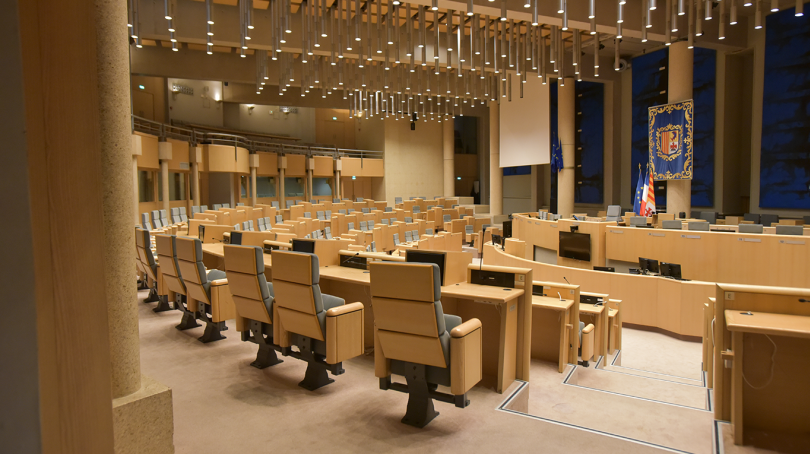
The debating chamber of the Provence-Alpes-Côte d’Azur (PACA) Regional Council, where the experiment was conducted. © Jean-Pierre Garufi / Région Sud, courtesy of Région Sud PACA.
Inequality arising from effort: for five minutes, participants copied complex symbols. Those who copied the most (that is, the more productive half) received 10 euros. Next came a test of inequality arising from social circumstances. Here, the organisers arbitrarily decided to award 10 euros to any participant born in Marseille. There followed inequality arising from luck. Each participant was assigned a colour, yellow or pink. Depending on a draw conducted publicly in the chamber, participants either received 10 euros or did not.
Finally came inequality tied to risk-taking. Each participant received 4 euros and was offered the opportunity, should they wish, to invest that money in a lottery ticket: winning tickets paid out 10 euros (a net gain of 6 euros). These four stages therefore created financial inequalities among the participants, ranging from 0 to 40 euros.
In the second phase, the researchers questioned participants about their preferences. They were asked to indicate whether they were, in principle, in favour of redistributing money from the wealthier to the less wealthy, across the four situations tested (inequality arising from social circumstances, from luck, from work, and from risk-taking). Each participant then learned what they had actually earned.
Redistribution policies were subsequently put to a vote. In each situation, participants voted on whether they agreed that 2.5 euros should be taken from the winners and given to the losers. Each vote was independent: participants did not know the outcome of any given ballot and could not therefore devise a strategy based on earlier results. The outcome allowed the researchers to observe the strategies participants adopted – ranging from an outright refusal of any compensation to a desire for maximum redistribution among all those taking part.
First, 86% of participants voted consistently from one ballot to the next. They either acted selfishly, seeking to protect their own position as far as possible, or acted selflessly, supporting certain forms of redistribution as a matter of principle. This finding confirms that the votes were not cast at random.
Second, not all inequalities were treated in the same way. Money won by chance (the sum acquired by participants born in Marseille, or by those who drew the correct colour) was readily surrendered for redistribution.
© Marisa Gonçalves de Almeida / Unsplash
By contrast, participants were far more reluctant to redistribute money that had been earned through effort (copying the symbols) or through risk-taking (the lottery game). It is as though some inequalities are regarded as deserved, while others are felt to be unjust. This result echoes the theory of the philosopher Ronald Dworkin: inequalities for which individuals are not responsible appear more unjust than those resulting from their own choices.
Finally, individual circumstances shaped participants' choices. A third of voters supported the arrangements most favourable to themselves (particularly if they had earned little during the money-distribution phase).
Can these positions be influenced by external factors? The researchers tested one possible lever: information. In real life, an individual's perception of their place on the social ladder directly shapes their attitude towards redistribution policies. That perception is often mistaken: French people tend to consider themselves more "average" than they truly are – the proportion of French people who believe they belong to the poorest 10% of households, or to the richest 10%, falls short of the actual figures.
In the Marseille experiment, half of the participants were informed of the whole group's earnings before voting. This information transformed their vote: these participants proved markedly more supportive of redistribution than the others1.
Raphaël Lardeux, « L’opinion des Français sur les inégalités reflète-t-elle leur position sur l’échelle des revenus ? » DRESS, Etudes et résultats, juin 2024, n°1234.
© Claudio Schwarz / Unsplash
A further lever was also tested. Before entering, some participants were invited to sign a petition for equal opportunity – one that advocated anonymous CVs as a means of preventing discrimination and nepotism – without realising that this invitation formed part of the experiment. Here again, the effect was clear: these participants voted more readily in favour of redistribution. A simple activation of values is therefore sufficient to influence choices.
This experiment demonstrates that ideas about social justice are relatively aligned: people are more inclined to correct inequalities tied to birth and chance than those resulting from individual choices (effort or risk-taking). This moral hierarchy can, however, be overturned by self-interest. Furthermore, such positions shift according to the degree of information available. The more individuals understand the reality of inequality, the more willing they appear to accept a sharing of resources.
At a time when debates over taxation, social protection, and pensions rank among the foremost political issues in France, one lesson stands out: preferences in matters of social justice are not merely a question of ideology. They also depend upon what individuals actually know about the world around them.

A media that makes economics accessible to all