

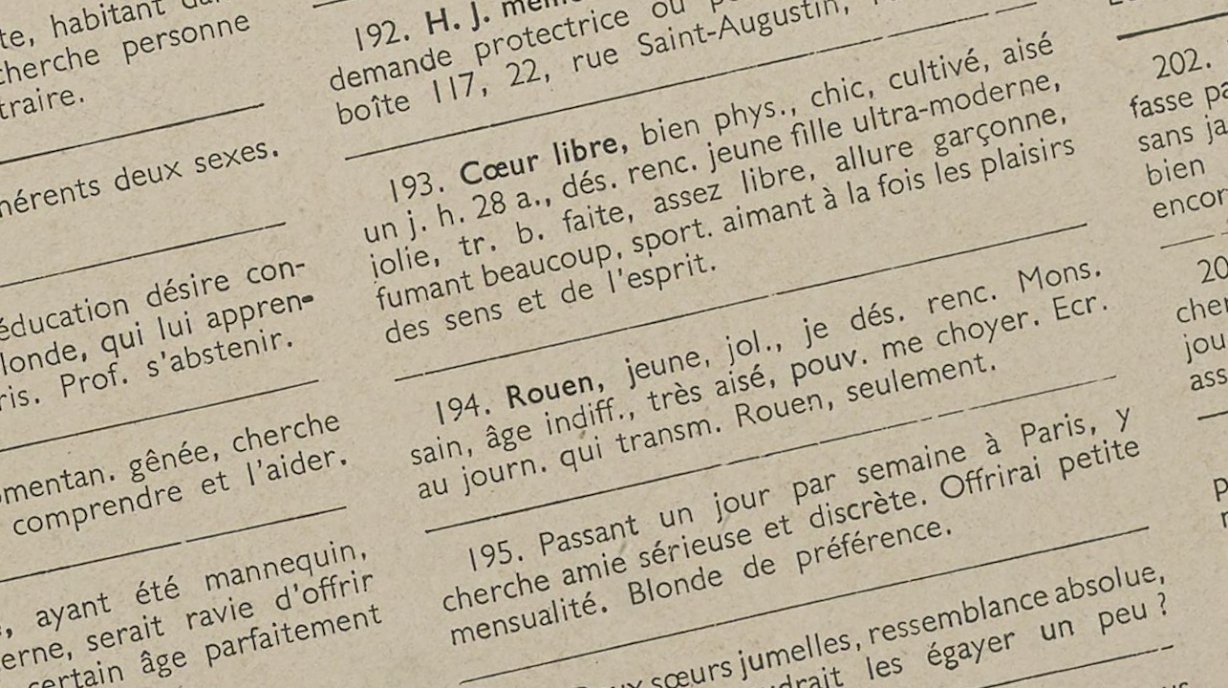
A million matrimonial ads from the past reveal changes in the criteria for love over the twentieth century, and hint at deeper transformations in societies themselves.
“Man, 28, from an excellent family, pleasant appearance, good prospects, wishes to marry young lady with a dowry.” Published in Le Chasseur Français1 in 1896, this small ad will now raise a smile. Who today would openly display their desire for income on Tinder or Match? And yet, at the time, speaking about money was perfectly natural. In 1903, a “keen hunter” about to return “to Tonkin” (as it was then called) specified the amount of his assets (8,000 francs in the colonies, 2,700 in France) to attract the “well-groomed and educated” woman of his dreams. In 1904, a “young man of high society, perfect in every respect, wealthy, fortune entirely in securities” declared without embarrassment that he was seeking a young woman “with land.”2
- 1
Le Chasseur français is a French monthly magazine mainly focused on hunting, fishing, and DIY. It is also known for its personal ads, which have been published almost continuously since 1895.
- 2
These examples, and the ones that follow, are cited by Marc Schliklin, “Le Chasseur français: 140 years of love stories,” www.lechasseurfrancais.com.
Marriage as an economic contract
This frankness is hardly surprising. When it comes to the question of who marries whom, the demographer and sociologist Alain Girard pointed out as early as 1964 that Cupid does not strike at random: people marry above all within their own social group1. It was not until the late 1970s that this social homogamy – the tendency to marry someone from the same background – began to decline. French society then became more open, although the tendency of graduates from elite schools to marry among themselves remained strong2.
What remains is to understand how this change came about. Is it because we now encounter people from different social backgrounds more frequently than in the past? Or because we place greater value on emotional harmony than on financial security? In other words, is the current evolution linked to a transformation of the ‘marriage market,’ or to a shift in our preferences? It is this question that economists Quentin Lippmann and Khushboo Surana set out to answer.
- 1
Girard Alain « Le choix du conjoint. Une enquête psycho-sociologique en France. Présentation d'un cahier de l'I.N.E.D ». Population, n°4, 1964.
- 2
Bouchet-Valat Milan, 2015, Les rouages de l’amour et du hasard. Homogamie et hypergamie dans la France et l’Europe contemporaines : dimensions socioéconomique et d’éducation, variations et mécanismes, Thèse de Doctorat en sociologie, Paris, Institut d’études politiques de Paris, 610 p.
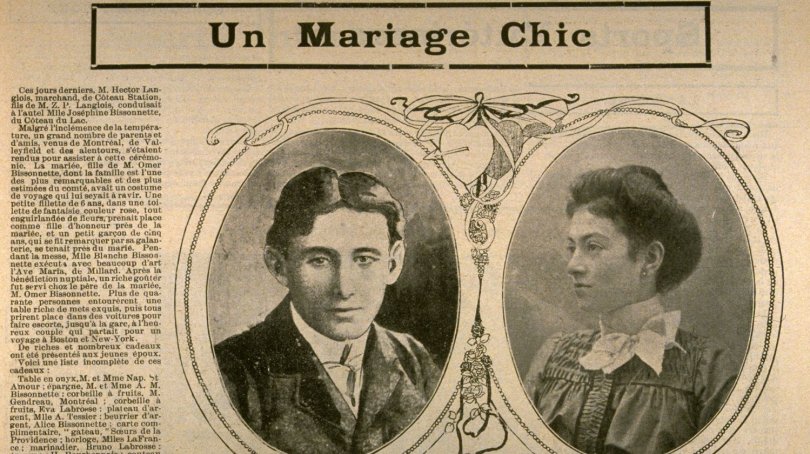
© Album Universel / Archives nationales du Québec (1902)
One million personal ads
In order to capture people’s desires even before any actual meeting took place, the two researchers turned to matrimonial advertisements published in France, North America and India. These ads were extremely popular throughout the twentieth century, even if they seem to have led to relatively few unions (between 1 and 3 per cent in France)5 .
The two economists collected around one million advertisements placed by those seeking a soulmate, published from 1950 up to 1995, the year Match.com – one of the first online dating sites – was created. They subsequently ‘read’ them, or rather subjected them to statistical analysis. This analysis was all the easier to automate given that the texts bear little resemblance to the complexity of medieval courtly poetry – paid for by the word, the ads are brief and efficient: “X (young man, widow, wealthy divorcee, etc.) would like to meet / would respond to / would marry Y (attractive musician, Paris-based executive, or man aged 38–45).”
By identifying the phrases linking the two parts of the ads, the researchers were able to isolate the offer (the person writing) from the demand (what they are seeking). It is this latter dimension that attracted their attention: whom are people looking for? What criteria guide their choices? To answer this, the researchers identified four categories of vocabulary based on the most frequently used words each year: economic terms; personality; tastes and cultural preferences; and physical characteristics. After controlling for various biases, they observed how the relative weight of each of these lexical registers evolved over time.
Romance in France and North America, social position in India
The vocabulary changes markedly. In the nineteenth century, as the historian Claire-Lise Gaillard has shown6, economic criteria were predominant in France. The two economists demonstrate that this trend, which they observe across all four countries studied, begins to shift from the late 1960s onwards.
In France and North America, the share of economic vocabulary declines significantly, giving way to a growing importance of terms describing personality (“pleasant,” “emotionally stable,” and so on) – with a particular emphasis on race in American advertisements. People now sought to meet a man who was “masculine, refined, intelligent, generous, well-off for a harmonious life’ (Le Chasseur Français, 1970), or even “a serious young romantic – if such a thing still exists” (ibid., 1973). Might this evolution simply reflect a new form of prudishness, where it may be inappropriate to mention financial criteria openly?
- 5
Bozon Michel et Héran François, « La découverte du conjoint », Population, 1987, 42 (6)
- 6
Gaillard, C. L. (2024). Pas sérieux s'abstenir-Histoire du marché de la rencontre. XIXe-XXe siècle. CNRS éditions.

A wedding in 1955 © Bibliothèque et Archives nationales du Québec / Fonds Champlain Marcil.
To verify this, the researchers also analysed how the authors of these ads described themselves. If economic criteria had remained a priority in partner selection, individuals would likely have continued to highlight their credentials in order to enhance their attractiveness. However, people stopped describing themselves in terms of their economic position, indicating that this criterion genuinely lost importance, both in what people offered and in what they sought – at least in advertisements published in France and North America. In India, however, the pattern is radically different. There, economic criteria become increasingly prominent in descriptions of the desired partner from the 1970s onwards. How can such divergent trajectories be explained?
Women’s economic independence
In Western countries, a decline in the mention of explicit economic criteria occurs in the late 1970s, at a time when ways of life were changing: marriage rates fell sharply, cohabitation became more common, divorce increased, and people had children later in life. Could these phenomena share a common cause, such as the growing participation of women in the labour market? In France, for instance, the employment gap between men and women narrowed dramatically between 1975 and today (reducing the gap from 36-points to 9-points)7. In the United States, women accounted for one in seven workers in 1966, compared with one in two by 2013. This hypothesis may, conversely, help explain the distinctive pattern observed in India. There, women’s participation in the labour market remained relatively low between 1950 and 20008. A closer examination of the vocabulary used in Indian ads seems to support this idea: within the economic lexicon, words relating to employment and work are the most frequent.
- 7
Observatoire des inégalités, « Emploi, la longue marche de l’égalité femmes-hommes », 17 mai 2024
- 8
« Renforcer la participation des femmes à l’activité économique en Inde : un nouveau vecteur de croissance ? », Etudes économiques de l’OCDE, 2014/17 p107-135 ; See also: Perruche C. “Le travail des femmes, pièce manquante de l'économie indienne”, Les Echos, 25 august 2023

Un mariage hindou, selon la coutume des Télougous, un des peuples du sud de l’Inde. © Doctorpori / Wikimedia Commons (2023)
Quentin Lippmann and Khushboo Surana naturally refrain from drawing hasty conclusions. Nevertheless, they suggest that their findings are consistent with the hierarchy of needs proposed by the American psychologist Abraham Maslow in 1943. This theory describes human needs according to their order of priority: eating, drinking and sleeping are fundamental needs which, once satisfied, allow individuals to turn their attention to others, such as self-esteem and fulfilment.
In the case of India, persistent material insecurity, despite the country’s economic development, may remain a primary concern, hence the foregrounding of financial criteria in choosing a partner. By contrast, the greater economic independence of women in Western societies encourages the search for relationships based not on material necessity – forming a household capable of meeting basic needs – but on the desire to build a harmonious partnership. Yet, whether this has made the search easier is doubtful, judging by the proliferation of websites promising miracle solutions for finding a soulmate.