


Growth and crisis

Even when the economy falters, wages hold up – and it's no accident. This is what a recent study conducted by a team of economists shows, revealing a key factor: employees' discretion.
Those reading from France have heard it time and again: growth is stagnant, the labour market is tightening, financial markets are uneasy. Elsewhere, the outlook is scarcely brighter. Across the Rhine, Germany celebrates having emerged from a recession, only to register an economic growth of 0.2 per cent. The OECD, for its part, warns of a slowdown in economic activity in 2026.
In such a climate, it is not unreasonable to feel anxious about the future, especially regarding the possibility of a reduction in one’s pay. Intuitively, one might expect pay to adjust to economic conditions. Yet, even in a recession, wage levels remain steady.1 This relative "rigidity" has puzzled economists for decades. It plays a key role in the functioning of the labour market and for the effectiveness of monetary policy, a major tool that helps stabilise the economy.
When a company sees its turnover decline, one might expect a reduction in wages to preserve profitability. More often, however, businesses opt for an alternative course: reducing the workforce. At the level of the economy, this makes employment the primary variable of adjustment, with predictable knock-on effects: lower consumption, reduced tax revenues, higher social protection spending, and so forth.
Bewley, T. F. 1999. Why wages don’t fall during a recession. Harvard University Press.

© Joyfotoliakid / Adobe Stock
Although wage rigidity is well established in economic analysis, along with its consequences for the macroeconomy, its underlying causes remain difficult to measure.
Anecdotes and managerial testimony collected by researchers in the 1990s2 suggested that firms are reluctant to cut wages for fear of damaging employee morale and productivity, and ultimately their own profitability. On this view, lowering wages may prove an ineffective means of reducing costs.
As plausible as this explanation may appear, it has been difficult to demonstrate a direct link between these managers’ perceptions and the likelihood of wage cuts. The difficulty lies in measuring something as intangible as employee morale and productivity in empirical data.
It is precisely here that Marco Fongoni, Daniel Schaefer and Carl Singleton offer fresh insight. They focus instead on a feature that can be more readily observed: managers’ perceptions of their employees’ discretion at work.
An employment contract cannot fully specify in advance everything an employee will have to do, nor the exact way in which he will have to do it. This is what is called the “incompleteness” of employment contracts. Even if a contract defines a position, a salary, working hours, or general responsibilities, it inevitably leaves some things unwritten. In this grey area, the employee must interpret, adapt, take initiative, and make choices between different ways of doing the job. The employee therefore has some “discretion”, room for action, a degree of latitude in carrying out their work.
Their hypothesis is straightforward. Where employees enjoy a degree of autonomy, they are also able to adjust their work pace. An autonomous worker may slow down, withhold discretionary effort, or simply do the bare minimum if a decision strikes them as unfair. Employers are well aware of this possibility. Therefore, the risk of a decline in productivity in response to a pay cut, depends on the degree of employee discretion, as perceived by managers.
For instance, a cleaner is seldom supervised while working throughout the day. If dissatisfied with their pay, they may cut corners, or at the very least refrain from going the extra mile.
See for example: Blinder, A. S., & D. H. Choi, 1990, “A Shred of Evidence on Theories Of Wage Stickiness.” Quarterly Journal of Economics, 105(4): 1003–1015
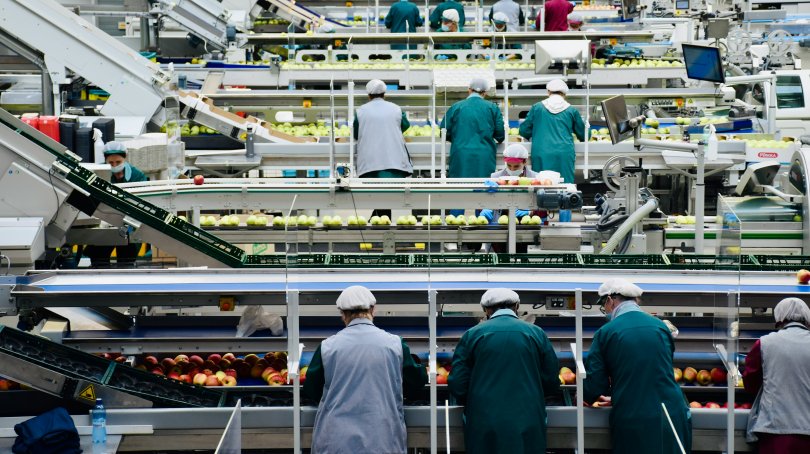
Photo de Arno Senoner sur Unsplash
By contrast, a production line worker at Renault has far less latitude in organising their tasks. Even today, assembly line employees must complete precisely defined operations within strictly timed intervals. Some office workers may in fact be less free than a cleaner, bound as they are by scheduled meetings, fixed deadlines and, at times, electronic timekeeping systems. In such contexts, a wage reduction cannot easily translate into lower effort or diminished productivity.
To measure discretion, the researchers drew on data from a 2004 UK workplace employment relations survey. By making use of survey questions to managers about workplace characteristics, they were able to distinguish between workers with and without discretion. Cross-referencing this information with payroll data on wages allowed them to assess the influence of employees’ discretion on pay changes.
Their findings are striking. Employees perceived by their superiors as autonomous are less likely to experience a pay cut. Over a two-year period, the probability of a wage reduction falls from roughly 17 per cent to 13 per cent when managers consider their staff to enjoy genuine autonomy.
The researchers go further, examining another dimension of working life: employee involvement, measured here by the extent of information sharing and discussion surrounding company decisions. Their results show that when employees are both autonomous and well informed, the protective effect of autonomy diminishes. A wage cut that is explained and understood may be seen as more legitimate, and thus less likely to provoke adverse reactions. By sharing economic constraints openly, employers reduce the risk of what might be termed “silent retaliation”. This finding echoes insights from management studies3 and occupational psychology.4
Eg. Sandvik, J., R. et al., 2021, “Employee Responses to Compensation Changes: Evidence from a Sales Firm.” Management Science, 67(12): 7687–7707
Greenberg, J., 1990, “Employee theft as a reaction to underpayment inequity: The hidden cost of pay cuts.” Journal of Applied Psychology, 75(5): 561–568
Discretion, however, protects just one thing—the employees’ leverage to resist nominal pay cuts5. Yet what matters for purchasing power is real pay, earnings adjusted for inflation. If your salary remains at €2,000 from one year to the next, its nominal value is unchanged. But if prices rise in the meantime, your purchasing power declines. Keeping wages stable does not prevent their erosion. Nominal rigidity protects chiefly against the visible shock, not against a gradual fall in living standards.
This study is the first to demonstrate the impact of often unseen factors, employees’ discretion and their involvement in decision making, on the likelihood of experiencing a pay cut. It shows that where work rests on autonomy and trust, reducing wages is not a mere accounting adjustment. Pay is not simply a price, a relative monetary value. It is also a symbolic signal, reflecting a sense of trust and reciprocity.
In economics, a nominal value, whether it is a salary or GDP, is a value that corresponds to the amount of currency in which it is expressed. A real value corresponds to this nominal value adjusted for the level of inflation. It is thus used to compare two monetary values at two different points in time.

A media that makes economics accessible to all