

Democracy

Often accused of dragging environmental policy downward, lobbying can, under certain conditions, have the opposite effect. Recent research shows that it can sometimes push governments to adopt more ambitious policies.
In the public imagination, lobbies are shadowy forces, diverting public action from the common good. The very word lobbying conjures images closer to corruption than to influence: backroom deals, envelopes of cash, whispered agreements struck in corridors between an elected official and a lobbyist. Unlike corruption, however, lobbying is not illegal. It is even legally regulated. In France, the so-called Sapin II law and the High Authority for Transparency in Public Life require interest groups to declare who they are, whom they represent, and the means they use to influence the legislative process. At the European level, more than 16,000 organisations are listed in the Transparency Register.
In practice, lobbying takes many forms: providing expertise, issuing recommendations and taking part in parliamentary hearings. In principle, any civically-minded citizen can write to their local member of parliament. In reality, few individuals are capable of delivering a “turnkey” amendment – like those that were sometimes adopted almost word-for-word during the examination of the 2025 Social Security Financing Billl1.
The resources available to an ordinary citizen bear no comparison with those of professional lobby groups, with their budget, in-house experts, and salaried specialists in interest representation. Nor are all lobby groups equal, and it is precisely this imbalance that raises questions.
Stoquer V. et l'Oeil du 20 heures, 11 novembre 2025, « Budget de la Sécurité sociale : comment des députés copient-collent des amendements rédigés par des représentants d’intérêts, sans les mentionner », France Info [online]
Boisselier A., 23 novembre 2025, « ENQUÊTE. Amendements : les parlementaires font-ils du copier-coller des lobbys ? », Ouest-France [online]
Last November, the European Parliament adopted the so-called “Omnibus” directive. Behind this ambiguous label lies a package of measures that weaken two directives passed in 2024: the CSRD and the CS3D, which imposed social and environmental reporting requirements and a duty of vigilance on companies operating in Europe. In concrete terms, firms were required to monitor, prevent, and remedy the environmental and human impacts of their activities across their entire value chain.
These directives had been hailed as a turning point following scandals in the textile industry, most notably the 2013 collapse of a building that killed more than 1,100 Bangladeshi garment workers and implicated several major Western brands. Since then, however, the legislation has lost momentum. Its implementation, initially scheduled for 2027, was postponed to 2028. In May 2025, the French president and the German chancellor went even further, calling for the CS3D to be scrapped altogether, arguing that it was too “burdensome” for European companies.
Their stance echoed that of industrial lobbies, which denounce excessive regulatory pressure and its impact on European competitiveness. NGOs, by contrast, see this retreat as a direct result of lobbying influence, at the expense of environmental and social ambition.
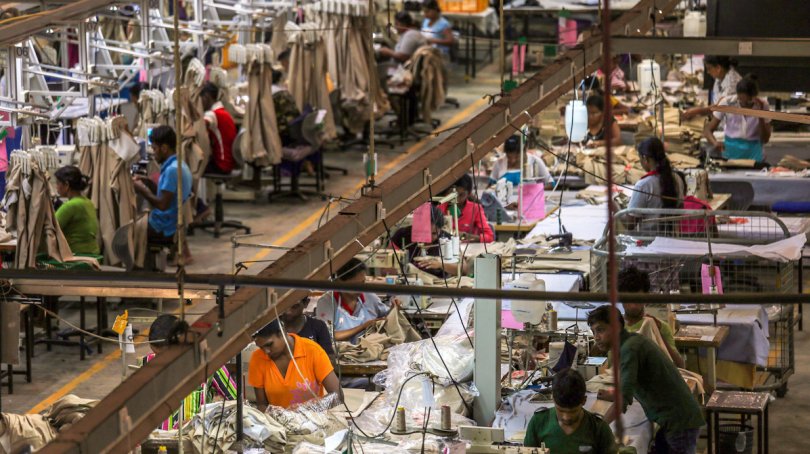
A production line in Weliveriya, Sri Lanka. © Asian Develoment Bank via Flickr (2014)
It is precisely this scenario that researchers Houda Hafidi, Philippe Bontems, and Guillaume Cheikbossian set out to examine. Their central question: how does the presence of lobbies affect governments’ willingness to adopt stringent environmental standards?
Their findings confirm a well-known intuition. In a free-market setting, states tend to engage in a race to the bottom when it comes to environmental standards, each hoping to attract economic activity and preserve the competitiveness of domestic firms. This tendency is all the stronger when pollution is transboundary — typically the case for greenhouse gases such as CO₂.
When pollution remains local — for example, a jeans factory discharging wastewater — governments are far more vigilant. They alone bear the environmental costs, while the economic benefits may be modest compared with the damage caused.
But what happens when pollution is global, and emissions in one country affect another? States could cooperate and commit to shared environmental standards, yet are often reluctant to relinquish part of their sovereignty over environmental regulation, which can serve as a lever of competitiveness. In a globalised economy, environmental standards can substitute for more traditional trade policy instruments, such as tariffs or taxes, to boost international competitiveness. Just as there is tax dumping — lowering taxes to gain an advantage — there is also social and environmental dumping, sometimes referred to as “eco-dumping.”
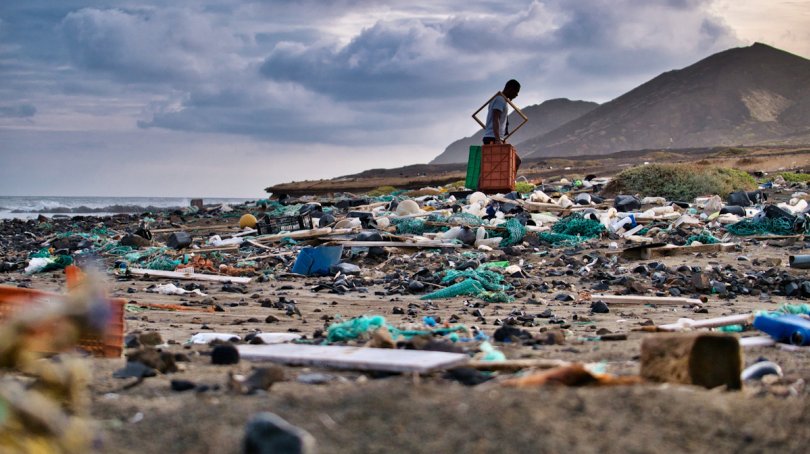
Plastic pollution at Santa Luzia, Cap-Vert ©Victor Rault via Wikimedia Commons
This is where lobbies come into play. Through their interactions with public decision-makers, lobbies shape how governments strike a balance between economic gains, social welfare, and environmental protection.
The researchers show that the impact of lobbying on overall social welfare depends on the relative strength of green and industrial lobbies, whose interests are clearly opposed. When their influence is relatively balanced, their confrontation can steer states toward a level of regulation close to the collective optimum — in other words, the outcome that best serves society as a whole, maximising economic benefits without allowing environmental damage to dominate. When green lobbies clearly prevail, overall welfare can even exceed what would be achieved under perfect cooperation between states. Conversely, when industrial lobbies are overwhelmingly powerful, standards are weakened and social welfare deteriorates.
The influence of green lobbies is all the greater when their action is internationalised. When green lobbies act separately, each within its own country, they tend to moderate their demands to avoid pushing production toward jurisdictions with looser rules. When they cooperate across borders, however, they can defend common standards, reduce the risk of relocation, and strengthen environmental ambition.
Whether among states or among lobbies, international cooperation emerges as a crucial condition for a credible climate transition. Without it, economic actors remain trapped in the logic of the global market, which rewards cost-cutting strategies at the expense of social and environmental goals.
Yet cooperation between states is becoming increasingly difficult as geopolitical tensions intensify and governments grow ever more reluctant to cede sovereignty over environmental and climate policy. In this context, lobbying can appear as part of the solution — provided that the balance of power favours green lobbies. Under such conditions, their influence can even replicate the effects of a genuine international environmental agreement.
The real question, then, is not “for or against lobbying?” but rather “what balance of power allows lobbying to serve, rather than undermine, the public interest?”. Against all expectations, it is sometimes green lobbies that can help governments stay the course.

A media that makes economics accessible to all